

Your cart is empty

What will replace HHC? H4CBD, THCV, THCP?
CBG9, THCP, THCJD, H4CBD, HHCP and HHCPO are now banned in France. Discover CBD as an alternative!
Since 2023, hexahydrocannabinol (HHC) has been added to the list of illegal substances, a regulatory change that has significantly impacted the cannabinoid landscape. HHC, known for its unique properties and often compared to THC, had attracted considerable interest within the scientific community and among consumers prior to its ban. This new regulatory reality has created an urgent need for research and development into legal alternatives to HHC. This article focuses on emerging cannabinoids such as H4CBD (tetrahydrocannabidiol), THCV (tetrahydrocannabivarin) and THCP (tetrahydrocannabiphorol), which may offer properties similar to those of HHC, whilst remaining within the legal framework.
We will explore the chemical structure, potential effects, and legal status of these alternative cannabinoids, examining how they compare to HHC and assessing their potential. The aim is to provide an in-depth understanding of these compounds, highlighting the implications of their discovery for the future of cannabinoid-based medical treatments and consumer products. By addressing key issues regarding safety, efficacy and legality, this article aims to offer an informed and detailed overview of these promising alternatives to HHC.
With constantly evolving regulations and growing interest in cannabinoids, it is essential to stay informed about the latest developments in this field. This introduction aims to put into context the importance of discovering and understanding new cannabinoids, highlighting their potential as a legal and effective alternative to the now-banned HHC.
H4CBD (tetrahydrocannabidiol): the wellness cannabinoid!
With the recent ban on hexahydrocannabinol (HHC) in 2023, the search for legal and effective substitutes has become a priority in the field of cannabinoids. Among the most promising candidates is H4CBD, a compound that could revolutionise our approach to cannabinoids.
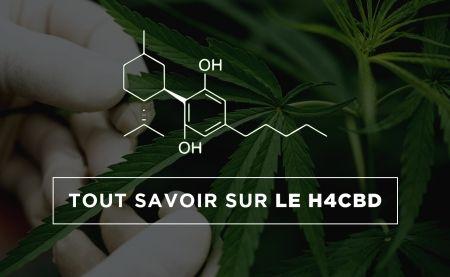
Chemical structure and properties of H4CBD
H4CBD, or hydrogenated cannabidiol, is a non-psychoactive cannabinoid that shares certain structural similarities with CBD (cannabidiol). Its unique molecular structure gives it distinct properties, particularly in terms of its interaction with the receptors of the endocannabinoid system. Unlike HHC, H4CBD does not bind significantly to CB1 and CB2 receptors, making it non-psychoactive and potentially safer for widespread use.
Potential effects and benefits
Preliminary studies on H4CBD have revealed several potential benefits. Due to its non-psychoactive profile, it is being considered for wellness applications without the mind-altering effects often associated with THC.
Researchers are exploring its anti-inflammatory, analgesic and anxiolytic effects, considering its use in various conditions such as chronic pain, anxiety, and even certain forms of epilepsy.
Current state of research on H4CBD
Although research into H4CBD is still in its early stages, preliminary results are promising. Clinical studies are needed to fully assess its efficacy and safety profile. In terms of applications, H4CBD could be incorporated into wellness products and supplements, offering a non-psychoactive alternative to THC-based products.
In conclusion, H4CBD appears to be a potentially ideal candidate to fill the void left by the ban on HHC. Its non-psychoactive profile makes it an exciting area of research for the future of cannabinoids. However, further studies are needed to determine its true potential and the best routes for its use.
THCV (tetrahydrocannabivarin): the slimming cannabinoid!
In the search for alternatives to HHC, THCV stands out as a remarkable candidate, offering distinct prospects in the field of cannabinoids. Whilst H4CBD focuses on non-psychoactive applications, THCV offers a unique profile that merits further exploration.
Chemical composition and interaction with the endocannabinoid system
THCV, a variant of cannabidiol, is distinguished by its chemical structure, which influences its interaction with the human body’s endocannabinoid receptors. This interaction differs from that of better-known cannabinoids such as THC, making THCV unique in its action and potential effects.
Properties and potential
THCV has attracted attention for its potential properties that could be beneficial in various aspects of wellbeing. One of the most notable characteristics of THCV is its effect on appetite regulation, which could have significant implications for the management of eating disorders or obesity. Furthermore, preliminary research suggests that THCV may have beneficial effects on blood sugar levels, which is promising for the potential treatment of diabetes.
Applications and ongoing research
THCV is still at the research stage, but its potential applications are vast. Studies are underway to assess its efficacy in managing various conditions, ranging from weight management to neuroprotection. These studies could pave the way for new treatment methods that capitalise on THCV’s unique properties.
Future prospects
The future of THCV looks promising, with ongoing research aimed at better understanding its effects and applications. Its clear distinction from other cannabinoids such as H4CBD and its potential across various fields make THCV an exciting subject of research and a potential candidate for future applications in the medical and wellness sectors.
In summary, THCV stands out for its unique profile and potential in research. Although different from H4CBD and lacking the psychoactive properties of HHC, THCV represents a promising avenue in the research and development of new cannabinoids with diverse therapeutic applications.
THCP (tetrahydrocannabiphorol): the sleep cannabinoid!
Continuing our exploration of alternatives to HHC, we turn our attention to THCP, a cannabinoid that is emerging with significant potential. Distinct from H4CBD and THCV, THCP is a relatively recent discovery that has generated considerable interest in cannabinoid research. It is notable for its potency, with unrivalled relaxing effects.
Chemical structure and interaction with the endocannabinoid system
THCP is distinguished by its unique chemical structure, which influences its interaction with endocannabinoid receptors. This structure gives it properties that could potentially surpass those of other cannabinoids in terms of efficacy in certain applications. Its affinity for CB1 and CB2 receptors suggests high potential! Tetrahydrocannabiphorol is thought to interact significantly with our receptors.
Potential and applications
Initial studies on THCP reveal promising characteristics. Although research is still in its early stages, scientists are particularly interested in its potential for alleviating chronic pain, inflammatory conditions and perhaps even certain neurodegenerative diseases. This range of potential applications positions THCP as an intriguing candidate in the field of cannabinoids.
Currently, it is primarily a cannabinoid used for its significant relaxing potential. THCP is said to be particularly valued for improving sleep!
Future prospects
Research into THCP is still in its infancy, but it is progressing rapidly. Scientists are striving to better understand its effects, safety profile and potential applications. As with any new compound, it is crucial to conduct thorough studies to assess its efficacy and safety before any clinical or commercial use.
THCP represents an exciting and rapidly expanding field within cannabinoid research. Although it differs from H4CBD and THCV in terms of chemical structure and potential, it shares their status as a non-psychoactive and legal compound. Its discovery opens up new avenues for the development of innovative treatments and highlights the importance of ongoing research in this dynamic field.
Comparison and analysis: H4CBD, THCV, THCP
Having examined H4CBD, THCV and THCP individually, it is essential to compare them and analyse their distinct characteristics, particularly in relation to their potential as alternatives to HHC. This section aims to provide an overview of these cannabinoids, highlighting their differences and similarities, as well as their potential applications.
Comparison of chemical properties and effects
- H4CBD: Non-psychoactive, focused on therapeutic applications without altering consciousness. Its unique molecular structure makes it of interest for anti-inflammatory and anxiolytic applications.
- THCV: Although it has a structure similar to THC, its effects are distinct. It has potential as a CB1 receptor antagonist at low doses, which may influence appetite and metabolism.
- THCP: Its unique chemical structure gives it a high affinity for CB1 and CB2 receptors, indicating significant potential for a variety of applications, particularly in the treatment of pain and inflammatory conditions, sleep disorders, and relaxation.
Legality and availability: H4CBD, THCV, THCP
Whilst HHC became illegal in 2023, it is essential to understand the legal status and availability of alternative cannabinoids such as H4CBD, THCV, and THCP. This section explores current regulations and the ease of access to these substances, crucial factors that influence their research, development, and potential use.
- H4CBD: Due to its lack of psychoactive effects, H4CBD is generally considered legal in many countries, provided it is derived from hemp sources that comply with local regulations. However, legislation may vary by region and requires constant attention.
- THCV: The legal status of THCV is somewhat more complex, as it is closely related to THC despite having radically opposite, non-psychoactive effects. In some countries, its legality depends on the THC concentration in the final product. It is crucial to check local regulations to ensure lawful use.
- THCP: As a relatively new discovery, the legal status of THCP is not yet well established. Its classification may depend on its classification alongside other known cannabinoids and the regulations in force in each country.
The legality and availability of H4CBD, THCV, and THCP play a major role in their future development and potential adoption as alternatives to HHC. As the regulatory landscape continues to evolve, it is essential to stay informed and comply with local laws to support the advancement of these promising cannabinoids.
In this article, we have explored H4CBD, THCV and THCP as potential alternatives to HHC, which has recently been made illegal. Each cannabinoid has a unique profile, offering diverse prospects for medical and wellness applications. H4CBD stands out for its non-psychoactive effects and its applications in wellness and relaxation. THCV, with its effects on appetite regulation and metabolism, opens up promising avenues for scientific research. THCP, meanwhile, offers significant potential in the treatment of pain and stress.
Warnings and recommendations
A crucial aspect when comparing these cannabinoids is their safety and efficacy profile. As research continues, it is imperative to evaluate these compounds not only for their potential therapeutic benefits but also for their safety in use. Furthermore, their legal status, in contrast to that of HHC, paves the way for wider exploration and use.
Although H4CBD, THCV, and THCP offer promising prospects as alternatives to traditional cannabinoids, it is crucial to adopt a cautious and considered approach to their use. The reckless use of these substances, particularly without medical supervision, may lead to adverse effects or unexpected drug interactions. It is important to emphasise that these cannabinoids are not universal remedies and that their efficacy and safety must be assessed on a case-by-case basis.
Users must exercise particular caution in certain situations. It is strongly advised against driving, operating heavy machinery, or performing tasks requiring sustained attention or motor coordination after using any product containing cannabinoids. Furthermore, vulnerable individuals, such as pregnant women, the elderly, or those with pre-existing medical conditions, should exercise increased caution.
Before considering the use of these cannabinoids, it is essential to consult a doctor or a qualified healthcare professional. Medical advice can provide personalised recommendations and help assess the risks and benefits based on individual health status and ongoing treatments.
See also
HHC banned: are THCP and THCV the new legal alternatives?