

Your cart is empty

THCV: What are the effects? More potent than CBD?
In a world where misinformation is rife, internet users are becoming increasingly demanding when it comes to the accuracy of the information they read. Contrary to what some might think, internet users are real little researchers when they’re missing crucial information.
When we consider the debate sparked by HHC (hexahydrocannabinol), it becomes clear that both supporters and critics were using similar terminology: although they held opposing views, they were in fact spreading the very same ideas, without any supporting scientific evidence or sources. Even the report by the ANSM (French National Agency for Medicines and Health Products Safety) confirming the ban on HHC stands out for its glaring lack of sources pointing to relevant scientific studies.
Now that THCV (tetrahydrocannabivarin) is entering the market, it is clear that the dictatorship of opinion (from both critics and supporters) risks tainting future debates concerning it. So, let us take a moment to look at the scientific studies that have been conducted and not give in!
What is THCV? What is its potential? Why does it affect us?
Key takeaways:
>>Order THCV products from our shop<<
What is THCV?
Chemistry lesson: the THCV molecule
A brief definition of THCV is in order. THCV, also known as ‘Δ9-THCV’, is also known by its full name, ‘tetrahydrocannabivarin’. Tetrahydrocannabivarin (THCV) does not have the same molecular structure as THC (tetrahydrocannabinol). It is what is known as a ‘propyl’ analogue, as indicated by the suffix ‘-varin’. A propyl group is distinguished by its molecular structure: it consists of a chain of three carbon atoms, in contrast to the pentyl group, to which THC belongs.
Its molecular formula is C19H26O2, meaning it contains nineteen carbon atoms, twenty-six hydrogen atoms and two oxygen atoms. There are two isomers associated with THCV: Δ8 and Δ9. Without going into detail, this means that the arrangement of the THCV molecule can vary slightly and produce different effects.
In fact, chemically speaking, THCV has the same atoms as CBDV (cannabidivarine), with the difference that CBDV contains seven isomers.
What can we say about this? That’s all well and good, but how can we interpret it? Chemistry is a science of precision and subtlety. Just because one molecule bears a passing resemblance to another does not mean they are the same. In this case, we are dealing with a molecule from the ‘propyl’ group, which can have very different effects from those of the pentyl group, as we shall see!
Tetrahydrocannabivarin: a phytocannabinoid
A brief reminder of what tetrahydrocannabivarin is and its significance for our bodies. THCV is a ‘phytocannabinoid’. This means it occurs naturally in plants, particularly in hemp.
Put simply, a phytocannabinoid is a cannabinoid synthesised by a plant, capable of binding to our cannabinoid receptors and, more broadly, of influencing our endocannabinoid system.
The endocannabinoid system is described by the French biologist Bernard Calvino as a regulator of the body’s homeostasis, that is to say, its balance. He states that this system acts via signalling pathways and “plays a regulatory role in pain, but also in appetite and food intake, nausea, motor function…”
That said, an external phytocannabinoid, capable of interacting with our endocannabinoid system, can alter the functioning of this well-established system. THCV may therefore potentially affect pain, food intake, anxiety, motor function, inflammation or even memory.
What can be said about this? Without judging it as good or bad, the aim is not to discredit the effects of phytocannabinoids on the body. These compounds, such as THCV, influence our balance and may hold great potential for researchers. We know that studies on CBD were significantly delayed by the negative image associated with cannabis. Today, the scientific community does not wish to repeat this mistake. As Nicolas Donzé, a chemist and toxicologist, stated in his article on the subject, we must not “allow the fog surrounding a single cannabinoid, THC, to obscure the qualities of the more than 100 other constituents”.
The scientific potential of THCV: the effects
So where should we look to understand the effects of THCV? The answer is simple: to scientific studies. Researchers are working tirelessly every day on the phytocannabinoids in hemp, and it would be a great shame to prioritise public opinion over scientific work. What does science say about the effects of THCV?
Appetite & THCV
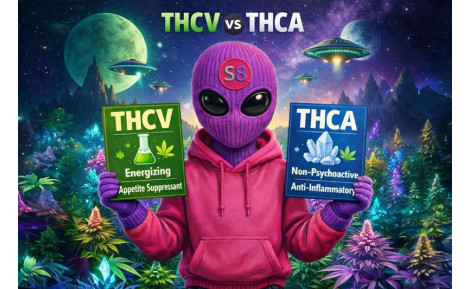
Tetrahydrocannabivarin shows some potential when it comes to appetite management. Unlike many cannabinoids, it is thought to have an appetite-suppressing effect, which could be of interest in the management of obesity or diabetes. A study in the Journal of Cannabis Research (vol. 2) entitled ‘Δ9-tetrahydrocannabivarin (THCV): a commentary on the potential therapeutic benefits for the control of obesity and diabetes” (trans.) indicates that THCV “reduces appetite, increases satiety and regulates metabolic energy”, which could be of interest in the context of weight loss and for patients with type 2 diabetes.
This study explains more specifically that the main effect of THCV does not necessarily concern food intake but rather the regulation of plasma glucose, insulin levels and liver triglycerides. Studies, mainly conducted in vivo on mice, demonstrate that tetrahydrocannabivarin acts on insulin sensitivity. This is also explained by a study in Nutrition & Diabetes, which demonstrated that THCV’s action was not so much on hunger and food intake as on metabolic regulation.
The advantage for the scientific community would be that THCV could replace Rimonabant, a controversial drug which, like THCV, acts as an inverse agonist on the CB1 receptor but causes a great many side effects. Tetrahydrocannabivarin could be a game-changer, offering the same metabolic effects without the side effects!
What can we say about it? THCV currently represents real therapeutic potential for the scientific community. It could play a role in the management of obesity and diabetes. However, studies are still ongoing. Before believing Instagram influencers who will tell you it’s a miracle cure for weight loss, it’s best to know that it’s only useful for people who genuinely need it.
THCV: a neuroprotective agent
Many scientists are turning to tetrahydrocannabivarin for its neuroprotective properties. A promising study on rats sought in particular to demonstrate that tetrahydrocannabivarin could reduce the symptoms of Parkinson’s disease. Why? THCV activates CB2 receptors (it binds to them and mimics our endocannabinoids) and may, conversely, act as an agonist/antagonist on CB1 receptors, which regulate processes in our nervous system. Furthermore, it appears that tetrahydrocannabivarin is a powerful antioxidant.
The study is encouraging! The results seem to indicate a slowing of the degenerative process. It would appear that it is not so much its action on CB2 receptors that is at play, but rather its antioxidant properties that could reduce the loss of certain neurons (notably dopaminergic nigrostriatal neurons), which are implicated in Parkinson’s disease. It is referred to as a ‘neuroprotective agent’.
Another study on mice, published in the scientific journal Neurobiology of Disease, also demonstrates that tetrahydrocannabivarin reduces dyskinesias (movement disorders) associated with Parkinson’s disease. It may also have anticonvulsant properties.
What can we say about this? Some studies do indeed demonstrate a neuroprotective effect of THCV. However, it should not be forgotten that the studies are still ongoing. Furthermore, to achieve this effect, it is necessary to take a precise dosage.
Tetrahydrocannabivarin and pain
In addition to its neuroprotective and metabolism-regulating potential, THCV has shown promise in the management of nociceptive pain (pain caused by damage to the body, such as in the case of an inflammatory reaction, for example). Several studies, listed in the article “Are cannabidiol and Δ9-tetrahydrocannabivarin negative modulators of the endocannabinoid system? A systematic review”, demonstrate that THCV enhances the antinociceptive (pain-relieving) potential of THC without causing THC’s side effects, such as anxiety.
What can be said about this? Tetrahydrocannabivarin has many roles, and by making good use of this phytocannabinoid, we can hope for healthier ways to relieve pain. It does not have the side effects of the psychoactive THC, nor those of other synthetic CB1 receptor inverse agonists, such as Rimonabant.
How does THCV act on our endocannabinoid system?
Tetrahydrocannabivarin acts on the receptors of our endocannabinoid system in a unique way. One could say that it is radically opposed to tetrahydrocannabinol (THC) in terms of its effects on our CB1 and CB2 receptors.
Whilst THC is a potent agonist of the CB1 receptor (it binds to it and strongly mimics the action of our endocannabinoids), THCV is an inverse agonist, or even an antagonist. It therefore produces the opposite effect: whilst one stimulates our receptors, the other barely affects them. This is why THCV is not psychoactive. Its neutral action on the CB1 receptor prevents it from becoming psychoactive.
However, it is worth noting, as many pharmacology articles do, that THCV does not act in the same way on our receptors depending on the dosage used. The aforementioned article “Δ9-Tetrahydrocannabivarin (THCV): a commentary on potential therapeutic benefit for the management of obesity and diabetes” encourages further research for this reason, as “[u]nlike THC, the therapeutic and clinical benefits of THCV, particularly its lack of psychoactive effects in human studies, are of great value for pharmacotherapy. However, on the other hand, the dual activity of THCV on CB1 and CB2 receptors, demonstrating agonist or antagonist effects depending on the dosage, indicates the need for further research.” (trans.)
Furthermore, the article “Are cannabidiol and Δ9-tetrahydrocannabivarin negative modulators of the endocannabinoid system? A systematic review” demonstrates that findings regarding the action of THCV vary depending on whether they were conducted in vitro or in vivo. There are therefore variations in results between laboratory tests and tests on living organisms.
This variety of results has also been described by Raphael Mechoulam, the Israeli chemist who first isolated the THC molecule, as contradictory in the British Journal of Pharmacology.
What can be said about this? The nature of THCV’s interaction with our receptors is not straightforward. Depending on the dosage and the nature of the study, tetrahydrocannabivarin appears to act as both a reverse agonist and an antagonist. This uncertainty regarding the effects of THCV on our endocannabinoid system still needs to be resolved by further studies, although the cannabinoid is extremely promising. It should be noted that most studies are conducted on laboratory rats or mice, which does not fully reflect its effects on humans.
Let’s wrap up!
Now that you have a clearer understanding of the issue, you can purchase THCV with the necessary critical eye. Tetrahydrocannabivarin is promising, but further research is still needed, particularly regarding the exact nature of its interaction with our receptors depending on the dosage. Most users take it to relax or alleviate everyday aches and pains. It is indeed a wellness compound and not a medicine.
>> Find our THCV products here <<